 Skip to content
 Brain tumours are complex medical conditions that can significantly affect neurological function and overall health. Early recognition of brain tumour symptoms, understanding brain tumour causes, and timely access to specialised brain tumour treatment can dramatically improve outcomes. Progressions in diagnostic imaging, neurosurgical techniques, radiation therapy, and targeted medical treatments now allow many patients to achieve long-term disease control and maintain a good quality of life.
This comprehensive guide explains what brain tumours are, their causes, symptoms, diagnostic methods, and modern treatment approaches available in Singapore, helping patients and families make informed healthcare decisions.
Has this article been insightful? Share it!
A brain tumour is an abnormal growth of cells within the brain or surrounding structures inside the skull. Also known as an intracranial tumour, it forms when cells multiply uncontrollably, creating a brain mass that disrupts normal brain function.
Brain tumours may be benign (non-cancerous) or malignant (cancerous). While benign tumours do not spread to other organs, they can still cause serious neurological complications by compressing vital brain structures. Malignant brain tumours, on the other hand, grow more aggressively and can invade surrounding tissue, often requiring urgent medical intervention.
Not all brain tumours are considered brain cancer. Some grow slowly and remain localised, while others behave aggressively and rapidly progress. Brain tumours are also classified based on their origin:
Because the skull is a rigid structure, even small abnormal brain growths can increase pressure inside the skull, potentially leading to permanent neurological damage. Early detection and treatment are therefore critical.
There are two main categories of brain tumours: primary brain tumours and secondary (metastatic) brain tumours.
Tumours arising from glial cells. These are the most common primary type, ranging from slow-growing to aggressive malignancies.
Usually slow-growing tumours from the brain's covering membranes. While often benign, they cause symptoms through compression.
Located in the pituitary gland, these often disrupt hormonal regulation and lead to various endocrine symptoms.
Also known as vestibular schwannomas, these affect balance and hearing by compressing specific cranial nerves.
These occur when cancer cells spread to the brain from other organs, such as the lung, breast, colon, kidney, or skin (melanoma).
Understanding tumour type is essential for selecting the most appropriate treatment strategy and predicting long-term outcomes.
The precise brain tumour causes remain unclear in many individuals. However, research has identified several biological and environmental factors that contribute to tumour formation.
One of the most significant causes of brain tumour development involves genetic mutations within brain cells. These mutations disrupt normal cell growth regulation, leading to uncontrolled cell division and tumour growth.
Exposure to ionising radiation, particularly radiation therapy to the head during childhood, is the strongest known environmental risk factor. Individuals who received radiation treatment for childhood cancers have a higher lifetime risk of developing brain tumours.
Certain hereditary conditions also increase susceptibility. These include genetic syndromes such as neurofibromatosis, Li-Fraumeni syndrome, tuberous sclerosis, and von Hippel–Lindau disease. In these cases, inherited genetic abnormalities predispose individuals to abnormal cell growth.
Despite extensive research, many patients develop brain tumours without any identifiable cause, highlighting the complexity of tumour biology and the influence of multiple interacting factors.
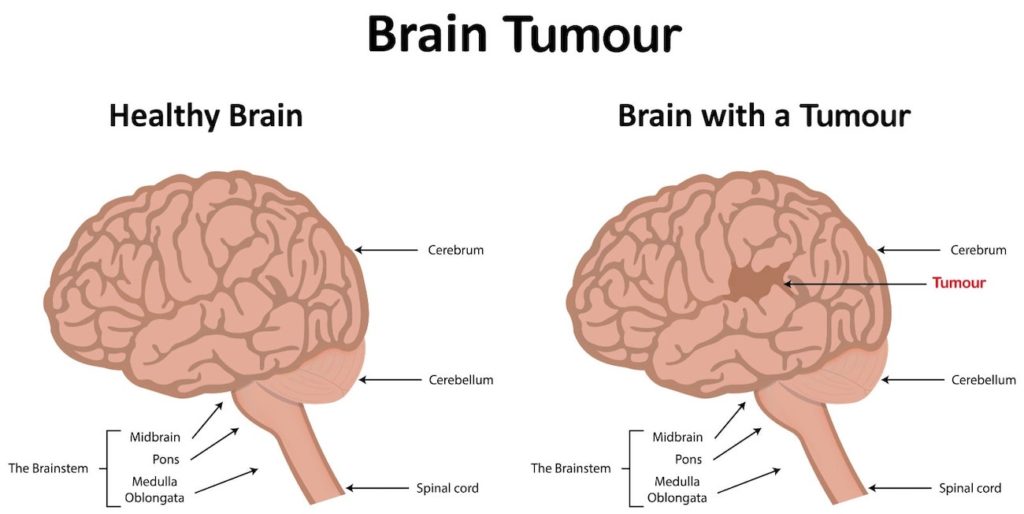
Several factors are associated with an increased risk of developing brain tumours:
Current scientific evidence does not support a direct link between mobile phone usage and brain tumour development, addressing a common misconception.
Identifying risk factors allows clinicians to monitor high-risk individuals more closely and encourage early diagnostic evaluation when symptoms arise.
Brain tumour symptoms vary depending on tumour size, growth rate, and location. Some symptoms appear gradually, while others develop suddenly.
Early brain tumour symptoms may be subtle and often progress slowly. These include:
As the tumour enlarges, more severe signs of brain tumour may develop:
Immediate medical attention is required for:
Early diagnosis significantly improves treatment success and long-term outcomes.
During your first consultation, the doctor will take a detailed medical history and perform a thorough neurological examination to assess cognitive function, reflexes, coordination, and muscle strength.
Depending on your symptoms, you may first be evaluated by a neurologist in Singapore before referral to a neurosurgeon for specialised investigations and treatment planning. Specialised imaging studies such as MRI or CT scans may be ordered to confirm the diagnosis and determine tumour characteristics.
Throughout this process, patients receive comprehensive guidance and emotional support, ensuring clarity and confidence in treatment decisions.
Accurate diagnosis is essential for determining prognosis and selecting optimal treatment. Diagnostic evaluation typically involves:
In many cases, a brain biopsy is performed to obtain tissue samples for histopathological and molecular examination. This allows precise tumour classification and WHO tumour grading, which determines tumour aggressiveness and guides treatment planning. Molecular testing is a mandatory test for brain tumor to get clear treatment plan and prognostication.
Combining specialised imaging and laboratory analysis ensures accurate diagnosis and personalised care.
Many brain tumours can be successfully treated, particularly when diagnosed early. Prognosis depends on tumour type, grade, size, location, patient age, and overall health.
Benign tumours often achieve excellent long-term control following surgery or radiation therapy. Some malignant tumours can be effectively managed with combined treatment approaches, allowing patients to maintain quality of life and neurological function.
Although not all brain tumours are curable, modern treatment strategies have significantly improved brain tumour survival rates and disease control.
Effective brain tumour treatment requires a personalised, multidisciplinary approach. Each patient’s care plan is tailored based on tumour characteristics, neurological function, and overall health.
Treatment strategies often involve collaboration among neurosurgeons, neurologists, radiation oncologists, neuro-oncologists, radiologists, and rehabilitation specialists. In complex neurological conditions, care pathways may overlap with treatment approaches used for traumatic brain injury, ensuring comprehensive neurological protection.
Brain tumour surgery remains a cornerstone of treatment. Surgical techniques include:
Surgical goals include maximal tumour removal while preserving neurological function. Minimally invasive approaches often lead to faster recovery, reduced pain, and shorter hospital stays.
Radiation therapy is used to destroy residual tumour cells or control inoperable tumours. Specialised technologies include:
These targeted treatments allow high-dose radiation delivery while minimising damage to surrounding healthy tissue.
Chemotherapy involves oral or intravenous medications that kill tumour cells or inhibit their growth. Modern targeted therapies act on specific molecular abnormalities within cancer cells, improving treatment effectiveness and reducing side effects.
Immunotherapy enhances the body’s immune response to tumour cells. Although currently applicable to selected tumour types, ongoing research continues to expand its role in brain tumour management.
Immediate medical evaluation is essential if any of the following occur:
While getting diagnosed with a brain tumour can be scary, it is important to get diagnosed as early as possible to increase your chances of successful treatment. If you are experiencing any of the symptoms associated with brain tumours, please do not hesitate to see a doctor as soon as possible. Your doctor will be able to accurately diagnose your condition and find a brain tumour treatment method that is best suited to your needs.
For care and support, the Advanced Brain and Spine Surgical Centre is here to help. Our team offers comprehensive diagnostic and treatment options, along with resources to help you manage your condition. Contact us today to schedule a consultation and learn more about how we can support you through this journey.
Brain tumours are serious neurological conditions that require early detection, accurate diagnosis, and personalised treatment. Recognising brain tumour symptoms, understanding potential brain tumour causes, and accessing timely brain tumour treatment significantly improve patient outcomes and long-term quality of life.
With advances in neurosurgical techniques, diagnostic imaging, radiation therapy, and medical treatments, many patients today benefit from effective disease control and enhanced survival. A multidisciplinary medical approach ensures that each patient receives comprehensive, tailored care throughout their treatment journey.
If you or a loved one are experiencing possible brain tumour symptoms or have been diagnosed with a brain tumour, early specialist evaluation is essential. Talk to us today to schedule a consultation with our neurosurgical team and discuss your personalised treatment options, specialised surgical techniques, and multidisciplinary care designed to achieve a favourable outcome.
Talk to us
Senior Consultant
Neuro & Spine Surgeon
MBBS, MSc Surgery, MRCS (Edin),
MMed. Sc (Gen Surg) (S'pore),
FRCS. Surgical Neurology (UK)
Dr Sein Lwin is an experienced Senior Consultant Neuro & Spine Surgeon and the Neurosurgical Director at the Advanced Brain and Spine Surgical Centre.
He is highly experienced in spine surgery and in minimally invasive approaches for spinal cord tumours and degenerative spine surgery. His specialised interests lie in endoscopic endonasal and open skull base surgery, pituitary tumours, vascular surgery, cranial nerve disorders and peripheral nerve conditions.
Many neurological conditions may require urgent attention. If you require immediate care, please contact us.
Contact Us For More Information
We provide quality specialised care for neuro and spine conditions.
For enquiries, leave a message and our friendly team will get in touch with you.
Monday – Friday: 9:00AM – 5:00PM
Saturday: 9:00AM – 12:30PM
Sunday & Public Holiday: Closed
We provide quality specialised care for neuro and spine conditions.
For enquiries, leave a message and our friendly team will get in touch with you.
Monday – Friday: 9:00AM – 5:00PM
Saturday: 9:00AM – 12:30PM
Sunday & Public Holiday: Closed
We provide quality specialised care for neuro and spine conditions.
For enquiries, leave a message and our friendly team will get in
touch with you.
Monday – Friday: 9AM – 1PM | 2PM – 5PM
Weekends & Public Holidays: CLOSED
Member of Beyond Medical Group
© 2023 All Rights Reserved | Advanced Brain & Spine Surgical Centre | Terms & Conditions
 Optimized by Seraphinite Accelerator